Remento vs Chorus: which voice keepsake is right for your family?
Product details and prices checked on 13 August 2026.
Quick answer
Choose Remento if you want to help one person tell the story of their life over several months. It sends that person regular prompts, records their answers and turns each recording into a written chapter. Family members can help choose questions, edit stories and react, but the book is organised around one named storyteller.
Choose Chorus if you want to gather stories and messages for someone from one person or a whole group. You can use it for a solo story, but it also allows siblings, friends, children and grandchildren to contribute separately. Each voice can have its own place in the finished book.
The main difference is the shape of the project:
- Remento: Tell us about your life.
- Chorus: Tell us about this person, this family or this occasion.
Both let families record stories, add photographs, read the words and hear the recordings again.
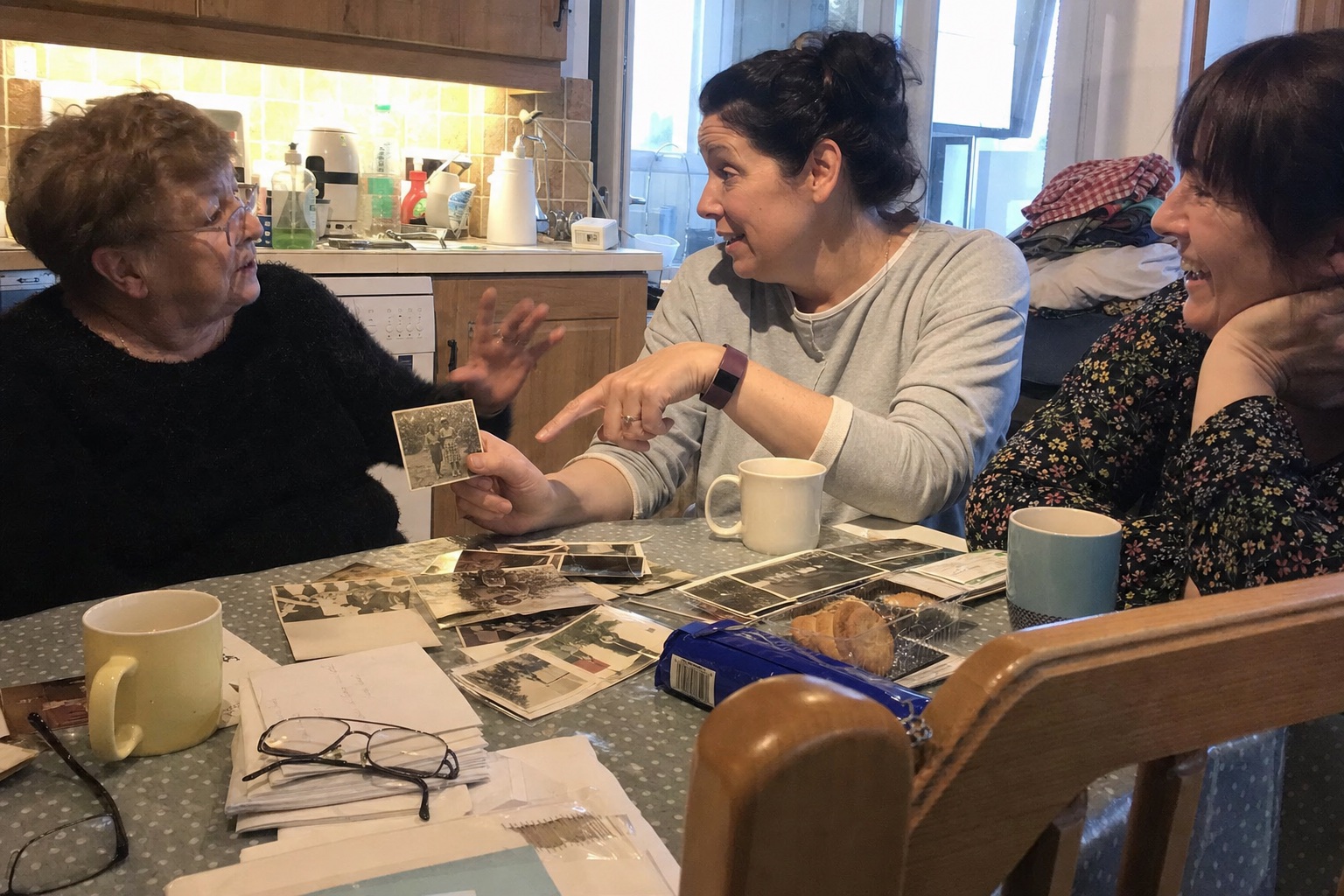
Remento and Chorus at a glance
| Remento | Chorus | |
|---|---|---|
| Main purpose | Document one person’s life stories | Gather voices and stories for one person or occasion |
| Project structure | One named storyteller, supported by collaborators | Solo contributor or a group of separate contributors |
| Typical timescale | Weekly prompts over a year | Built around an occasion or family project |
| Who records? | The named storyteller. Collaborators currently cannot record as themselves | One person or as many contributors as the organiser invites |
| Prompts | Large prompt library and scheduled questions | Contributors respond about the recipient or occasion |
| Contributor access | Collaborators create free accounts | Contributors use one link with no app or account |
| Written version | Transcript or an editable, polished narrative | Each message is written out and kept with its recording |
| Photographs | Added to prompts, stories and book chapters | Each contributor can add photographs with their message |
| Printed format | Hardcover life-story book | A book organised around the recipient and contributors |
| Audio access | QR codes in the printed book | Recordings play from their pages in the online book |
| Starting price | $99 for one year and one book credit | Free to gather, however many voices; pay only to keep it |
| Subscription | One year included; optional renewal | Current Chorus pricing is tier-based rather than annual |
| Best suited to | A parent or grandparent recounting their life | Birthdays, grandparents, weddings, families and group keepsakes |
Pricing and product details can change. Check Remento and Chorus before ordering.
What is Remento?
Remento is designed to help one person tell their life story without having to write it.
A family member usually buys the project for a parent, grandparent or other relative. The family chooses questions, and Remento sends prompts to the storyteller by email or text. The storyteller opens the prompt and records an answer.
Remento’s Speech-to-Story system can turn the recording into an exact transcript or rewrite it as a flowing narrative. The family can review and edit the result before including it in the book.
At the end of the project, the selected stories and photographs are printed as chapters in a hardcover book. QR codes beside the chapters open the original recordings.
What Remento includes
Remento’s standard $99 package currently includes:
- One named storyteller
- One year of access
- Unlimited story prompts
- Recordings of up to 30 minutes per story
- Unlimited collaborators
- Speech-to-Story processing
- Storage for recordings, stories and photographs
- One hardcover book credit covering up to 200 pages
- QR codes linking to the original recordings
- Free shipping for the included book in the US
A book can be expanded from 200 to a maximum of 380 pages for an additional $30. Extra hardcover copies of books up to 200 pages are listed at $69 each.
Remento says standard shipping takes approximately 21 business days after the book is ordered. International shipping is available to selected destinations for an additional charge. Remento pricing guide
What Remento collaborators can do
“Collaborator” does not mean that the other family members are passive.
Remento collaborators can:
- Suggest and select prompts
- Add custom questions
- Add photographs
- Read and listen to completed stories
- React to stories
- Edit the storyteller’s written stories
- Order copies of the book and choose which stories to include
- Help assemble and order the book
What they cannot currently do is record in their own name. Remento’s collaborator guide is explicit about it:
“As a collaborator, you currently cannot record your own stories. If you do record, they will appear as if they are the storyteller sharing them.”
Remento collaborator guide, checked 13 August 2026Collaborators join the storyteller’s project using a free account, and there is no separate payment. Remento describes the standard book as being designed for one storyteller.
That distinction matters. The book’s subject and narrative centre remain the named storyteller.
What is Chorus?
Chorus gathers recorded messages, stories and photographs into a book for one recipient or occasion.
One person starts the book and shares a contribution link. A contributor opens the link, says who they are and how they know the recipient, then records. They can add photographs to accompany what they have said.
No app or contributor account is required.
The organiser can invite one person or sixty. A Chorus project can therefore take several forms:
- One person recording a longer account
- One person contributing several separate stories
- Siblings remembering their childhood together
- Friends recording messages for a birthday
- Children and grandchildren making a book for a grandparent
- Wedding guests contributing stories and photographs
- Different family members remembering someone who has died
A solo Chorus book is still a valid Chorus book. The difference is that the structure does not require one principal storyteller. More people can be added without turning their contributions into supporting material for somebody else’s memoir.
What Chorus includes
Chorus currently allows an organiser to begin collecting without paying or entering card details.
The free gathering includes:
- One contribution link
- Every voice, however many record
- Photographs from contributors
- Recordings available to download
- No app or contributor account
The current paid options are below. The prices are on the pricing section of the home page.
Voices
- Each recording tidied
- One link that plays every voice straight through
Book
- The recordings
- Written versions of the messages
- The finished book laid out to read
- Every message playable from its page
Keepsake
- One printed hardcover copy
- Posted to you
- Extra copies available separately
- Everything included in the Book option
Current prices are shown on the Chorus website.
The biggest difference: whose story is being told?
This is the first question to answer before comparing covers, prices or page counts.
Remento begins with the storyteller
A Remento project begins by choosing the person whose life will be recorded.
The prompts are addressed to that person:
- What was your childhood home like?
- How did you meet your partner?
- What was your first job?
- Which family traditions mattered to you?
- What have you learned from becoming a parent?
The resulting book is that person’s account of their life.
Family collaborators can shape the questions and take part, but their role is primarily to help the storyteller’s memories emerge and to prepare the book.
This is a useful structure when the family has one person whose story it wants to document.
Chorus begins with the recipient or occasion
A Chorus project can begin with a person’s birthday, a wedding, a new baby, a grandparent, a family period or someone being remembered.
The questions are often addressed to the contributors:
- What is your earliest memory of Mum?
- What did Grandad teach you?
- Which day with Sarah can you still picture?
- What story about John still makes you laugh?
- What would you like Martha to hear on her wedding day?
The recipient does not have to interview themselves or recount their entire life. Other people bring the parts they remember.
One person may describe a school trip. Another remembers working with them 20 years later. A grandchild knows the songs they sing in the car. Their sibling remembers what they were like before anybody else in the book knew them.
That creates a different record. It shows the person through several relationships.
Can you use Chorus for a solo story?
Yes.
You do not need a large group to use Chorus. One contributor can record a story, or one person can contribute several memories.
A solo Chorus project may suit you if:
- You have one recording you want to keep with its photographs
- You want to tell the story behind a family album
- One relative is responsible for recounting a shared period
- You are recording a parent or grandparent in several sittings
- You want the option to add other voices later
- You are making a shorter book around a particular person or occasion
Remento gives a solo storyteller a structured year of prompts and a memoir-like chapter system. Chorus gives the organiser more freedom over the number and relationship of the voices.
Can Remento contain several voices?
Not as separate, named voices.
Remento’s collaborator guide states that collaborators currently cannot record their own stories, and that anything they do record will appear as if the storyteller shared it. So a relative’s recording can end up inside the book, but attributed to the storyteller rather than to them.
Remento’s standard purchase also includes one storyteller account, and its own pricing guide lists an additional storyteller at $99, which resets the renewal date for every storyteller on the subscription. If you want two principal storytellers, that is a second purchase.
With Chorus, separate contributors are the default structure. Each person identifies themselves and their relationship to the recipient. Their recording does not have to be edited into the voice or narrative of one central storyteller.
How the recording experience compares
Recording with Remento
The storyteller receives a prompt by text or email. They follow the link and record from a phone, tablet or computer.
Remento says the storyteller does not need an app, password or login to answer their prompts. A recording can last up to 30 minutes.
This is particularly useful for someone who enjoys talking but would avoid a written memoir project.
The weekly schedule also removes the need to decide when to record. A new question arrives, the storyteller answers it and the book builds gradually.
Recording with Chorus
The organiser shares one contribution link by text, email or family group chat.
Each contributor opens the link and records on their phone. They do not need an app or account. They say who they are and how they know the recipient, which keeps their recording attached to the right person in the book.
The same link can be shared with everyone.
This is useful when the organiser does not want to create accounts, assign individual logins or explain a different process to every relative.
It is also a better fit for an occasion with a real deadline. The organiser can ask everyone to contribute before a birthday or wedding rather than waiting for a year of weekly prompts.
Prompts and questions
Remento offers a developed memoir-prompt system
Remento has hundreds of prompts designed to draw out a person’s life story. Family collaborators can select prompts, suggest their own or use photographs as the starting point.
The scheduled prompt is one of Remento’s strongest features. It gives a hesitant storyteller a manageable task rather than asking them to “write their life story.”
Families planning a broad memoir may value the continuity of receiving questions throughout the year.
Chorus questions are about the person and relationship
Chorus contributors do not need to cover a complete chronology.
A good contribution may begin with:
- One day they remember well
- A habit that makes the person recognisable
- Something the person did for them
- A piece of advice they still use
- A story connected to one photograph
- Words they want the recipient to hear
This tends to produce shorter, relationship-specific accounts.
It also avoids asking every contributor the same broad question. The organiser can ask a sibling about childhood, an old colleague about work and a grandchild about the ordinary things they do together.
How the written stories compare
Remento can reshape speech into a narrative chapter
Remento provides two main written treatments:
- A word-for-word transcript
- A polished narrative generated from the recording
The storyteller or collaborators can edit the chapter before it is printed. They can adjust its length and presentation.
This suits a memoir where the family wants spoken recollections turned into longer, readable chapters.
It also introduces an editorial decision. The family needs to choose how much the written version should be polished and check that the edited chapter still says what the storyteller meant.
The original recording remains available through the QR code, so readers can compare the written chapter with the speaker’s delivery.
Chorus keeps each message with its contributor
Chorus writes out each recorded message so it can be read as well as heard.
The written message remains attached to the named contributor and their relationship to the recipient. In a group book, this separation matters. Sarah’s story stays Sarah’s; Denis’s words stay Denis’s.
This format is closer to a collection of spoken letters and family stories than a continuous autobiography.
How photographs are used
Both services allow photographs, but they use them in slightly different ways.
Photographs in Remento
A photograph can be used as the prompt for a story. The storyteller sees the picture and records what they remember about it.
Photos can also be added after recording and placed within the printed chapter.
This works well for family albums where the main task is identifying people, places and events while the storyteller can still explain them.
Photographs in Chorus
Each contributor can add photographs with their message.
The photograph may come from the contributor’s own part of the recipient’s life: a school photograph from one friend, a family holiday from a sibling, or a recent photograph from a grandchild.
This can give the final book a broader visual record because contributors are drawing from different collections.
The finished books
Remento’s book
Remento produces an 8 × 10-inch colour hardcover.
Each selected story becomes a chapter containing written text, photographs and a QR code linking to the original recording.
The included credit covers up to 200 pages. Customers can pay to extend the book to 380 pages.
Remento is suitable for a substantial life-story book built over many months.
Chorus’s book
A Chorus book is organised around the people who contributed and the person or occasion they are recording for.
Each contributor’s page can contain:
- Their name
- Their relationship to the recipient
- Their photograph
- Their written message
- Access to their original recording
This makes it easy to move between voices without blending them into one continuous narrator.
The Keepsake option includes one printed hardcover copy, posted. Extra copies can be ordered separately, which is useful when siblings or different parts of a family each need one.
Which is easier for older relatives?
Neither service requires the main recording contributor to download an app.
Remento sends the storyteller a direct prompt by email or text. They open it and record.
Chorus gives contributors one shared link. They open it, identify themselves and record.
The practical difference is in the surrounding work:
- A Remento storyteller receives repeated prompts over time.
- A Remento collaborator needs an account to help manage the project.
- A Chorus contributor does not need an account.
- A Chorus organiser may need to remind several people before the deadline.
For one older relative recording weekly, Remento’s repeated prompt system may be easier.
For ten relatives contributing once, Chorus’s shared link is likely to involve less setup.
How long does each take?
Remento is designed to unfold over a year
The standard purchase includes one year of prompts and platform access.
You can record more quickly, but the product is built around the idea that stories emerge gradually. A prompt arrives, the storyteller responds, and the family follows the growing collection.
Printing and standard delivery take approximately 21 business days according to Remento’s current pricing guide.
Chorus is organised around the date you choose
A Chorus book can be gathered for a birthday, wedding or family occasion.
The organiser decides when contributions close. Contributors can record as soon as they receive the link.
For a printed gift, allow time to:
- Share the link
- Remind contributors
- Check that the important people have taken part
- Prepare the book
- Print and deliver it
For a group project, beginning around six weeks before the occasion gives contributors time to respond and leaves at least three weeks for printing and delivery.
Price comparison
The prices are charged in different currencies and cover different kinds of project, so a direct number-to-number comparison is limited.
Remento
Remento currently charges $99 for:
- One year of access
- One storyteller account
- Unlimited collaborators
- Unlimited prompts and recordings
- One hardcover book credit up to 200 pages
- US shipping for the included book
Optional costs include:
- $30 to expand the book up to 380 pages
- $69 for an additional hardcover copy up to 200 pages
- $99 for each additional storyteller
- International shipping
- Renewal at $99 annually or $12 monthly if the family wants to keep creating new material after the included year
Existing recordings and stories remain available if the renewal is cancelled, but creating new stories requires an active subscription. Remento subscription guide
Chorus
Chorus currently offers:
- Free gathering: unlimited voices and photographs
- Voices: the editing, and the one link that brings every voice together
- Book: written and playable messages assembled as a finished book
- Keepsake: one printed hardcover copy, posted
Chorus does not currently present these as annual subscription prices.
Privacy and long-term access
Remento says customers can download recordings, photographs and written stories at any time. Its printed QR codes link to the original recordings, and the company says existing content remains available after cancellation.
Chorus allows the organiser to download every recording, including during the free gathering. Downloading local copies is sensible whichever service you choose.
No family archive should exist in only one online account. Keep copies of the recordings and photographs in family-controlled storage too.
Choose Remento if…
Remento is likely to suit you better when:
- One parent or grandparent is the clear storyteller
- You want to document a broad life story
- The storyteller prefers speaking to writing
- Weekly prompts would help them continue
- You want longer memoir-style chapters
- You want speech transformed into an editable narrative
- You expect the project to take several months
- You want a large hardcover with up to 200 or 380 pages
- You are ordering in the US and value included domestic shipping
A typical Remento project might be a daughter helping her father record the story of his childhood, working life, marriage and family over a year.
Choose Chorus if…
Chorus is likely to suit you better when:
- Several people have stories about the recipient
- You are making a gift for a birthday or wedding
- You want each person’s voice kept separately
- Contributors know the recipient from different parts of their life
- You want one shared contribution link
- You do not want contributors to create accounts
- You want to begin collecting before paying
- You need one recording, several stories or a whole group
- You want photographs drawn from several family collections
- You need several copies for different relatives
A typical Chorus project might be a 70th birthday book containing a childhood story from the recipient’s sister, a work story from an old colleague, messages from their children and the ordinary memories their grandchildren know best.
Which one should you buy?
Choose based on the story you are trying to collect.
If the sentence is:
“I want Mum to tell us about her life.”
Remento has the more developed structure for that job.
If the sentence is:
“I want all of us to tell Mum what we remember about her.”
Chorus is built for that shape.
If you are recording one person but may later want to add siblings, friends or grandchildren as separate contributors, Chorus leaves that route open.
If you want a year of scheduled questions leading to a substantial autobiography, Remento is likely to be the better fit.
Both products can preserve a voice beside written stories and photographs. The decision is whether you want one person’s account to form the centre of the book or a book in which several accounts sit alongside one another.
Start gathering voices with Chorus
Is Chorus a Remento alternative?
Yes, when the aim is to create a voice keepsake or family book. The products organise the material differently. Remento centres a named storyteller’s life; Chorus can gather solo or group contributions for a person or occasion.
Can Remento record more than one person?
Not as separate voices. Remento’s collaborator guide says collaborators currently cannot record their own stories, and that anything they do record appears as if the storyteller shared it. The standard purchase includes one storyteller account, and a second principal storyteller costs an additional $99.
Can I make a solo book with Chorus?
Yes. A Chorus project can begin with one contributor and one story. More voices can be added if the organiser wants them.
Do contributors need an app?
Remento’s main storyteller can answer prompts without downloading an app or logging in. Remento collaborators use free accounts to help manage the project. Chorus contributors use one link and do not need an app or account.
Do both services include the original voice?
Yes. Remento links printed chapters to recordings using QR codes. Chorus keeps each recording playable from its page in the online book.
Which is better for grandparents?
Remento is a strong choice when the grandparent will be the principal storyteller recounting their life. Chorus is a strong choice when children, grandchildren, friends and relatives will contribute their own stories about the grandparent. Chorus can also be used for a solo grandparent recording.
Which is better for a milestone birthday?
Chorus is shaped around occasions and group contributions, so it is generally the closer fit for a milestone birthday. Remento may suit a birthday gift that begins a longer year of recording rather than being completed for the birthday itself.
Which is better for a family history project?
Remento suits a family history told mainly through one relative’s recollections. Chorus suits a family history assembled from several relatives whose accounts may overlap or differ.
Does Remento require a subscription?
The initial $99 purchase includes one year. Renewal is optional at $99 a year or $12 a month, but an active subscription is required to create new stories after the included year. Existing material remains available after cancellation.
Can I download the recordings?
Both services provide recording downloads. It is worth keeping family-controlled copies whichever one you choose.
Sources checked
Remento’s product details, prices and collaborator rules on this page were read from Remento’s own site and help centre on 13 August 2026: