You don’t have to ask your grandparents to tell their whole story
Save this for the next time the family is together.
Looking for the questions themselves? 30 questions to ask your grandparents about their life is the list for sitting down with them. This page is for when that conversation is hard to start.
There is one problem with asking someone to record their life story: it can feel like work.
"Tell us about your life" is a big question.
Some grandparents will love it. Others may not know where to start, may feel self-conscious about recording themselves, or may simply wonder why anyone would be interested in stories that feel ordinary to them.
There is another way to preserve your grandparents' memories.
Ask your family to tell them what their memories mean
Instead of only asking your grandparents to contribute their own stories, ask the rest of the family to contribute their memories of them.
For example:
"I still remember you teaching me how to pick blackberries. I loved those afternoons."
Or:
"One of my favourite memories is you baking those scones. I can still remember what the kitchen smelled like."
Or:
"I loved when you used to collect me from school and we'd always stop for something on the way home."
Or simply:
"I found this old photo of us. I don't remember where we were, do you?"
These are much easier conversations to start.
They don't ask someone to sit down and produce the story of their entire life.
They give them a memory to respond to.
And often, that memory opens the door to many more.
Ask your family what they remember about your grandparents
A grandparent's story doesn't only belong to the grandparent.
Their life has been experienced by children, grandchildren, siblings, friends, partners and generations of family.
If you're trying to preserve your grandparents' memories, ask the people around them what they remember too.
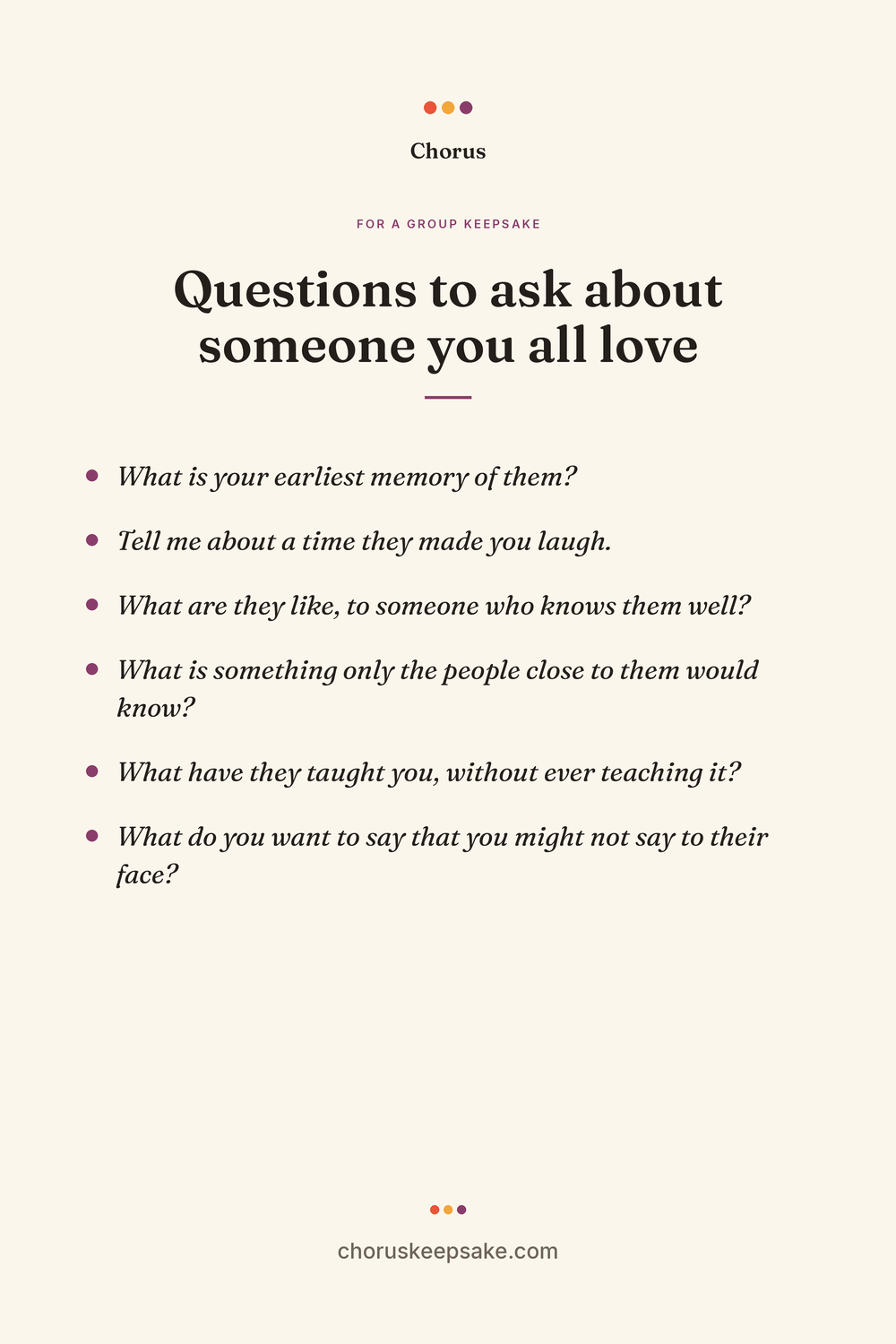
Useful questions include:
- What's your favourite memory of them?
- What did they always do that made you laugh?
- What did they teach you?
- What food do you associate with them?
- What places remind you of them?
- What family traditions did they create?
- What did they do for you that you still remember?
- What is something they probably don't realise meant so much to you?
- Is there a photograph that brings back a particular memory?
- What is something you hope future generations know about them?
These answers can become part of the family story too.
Ask your children and grandchildren for their memories
If you're creating a family memory book or recording a grandparent's life story, don't only ask the older generation questions.
Ask grandchildren what they remember.
A child's memory might be something seemingly small:
- baking with Grandma
- picking blackberries with Grandad
- being collected from school
- sitting beside someone at the kitchen table
- hearing the same story every Christmas
- being taught how to do something
- a particular holiday
- a favourite meal
- a phrase their grandparent always used
Those details may not appear in a traditional family history, but they are often the memories that make a person feel real to future generations.
Give them something to remember
Sometimes the easiest way to get a story is not to ask a question.
Give them a memory.
Share a photograph.
Upload an old family picture.
Tell them about something you remember.
Send them a message saying:
"I was thinking about those summers when we'd go blackberry picking. I don't think I've ever told you how much I loved that."
Then ask:
"Do you remember those days?"
That question is very different from:
"Please record your life story."
One asks for a performance.
The other starts a conversation.
And when your grandparent responds, you may discover a story you have never heard before.
Use photographs to unlock family stories
Old photographs can be one of the easiest ways to start a conversation with grandparents.
Instead of simply asking, "Who is this?", try asking:
- Where were you?
- What year was this?
- Who else was there?
- What had happened that day?
- What do you remember about this place?
- What happened before or after the photograph?
- Is there anyone in this photograph I don't know?
- What was life like at this time?
A single photograph can turn into a story about a house, a relative, a holiday, a friendship or an entire period of someone's life.
This is particularly valuable when you're trying to preserve family history, because photographs often contain people and places that younger generations can no longer identify.
The best family memory books are not one person's story
This is where preserving family memories becomes more interesting.
A memory book for grandparents doesn't have to be a biography written by one person.
It can be a collection of how a family remembers one another.
Your grandmother might contribute a story about growing up.
Her daughter might contribute a photograph from her childhood.
A grandchild might write about learning to bake with her.
Another grandchild might record a voice message about summer holidays.
Someone else might remember a family tradition that everyone else had forgotten.
Together, those pieces create something none of them could have created alone.
It's not either/or. It's both.
Your grandparents can tell their own stories.
And their children and grandchildren can tell stories about them.
They can share memories.
And the family can share photographs.
They can record their voices.
And everyone else can add messages, memories and moments that matter to them.
They can remember the major events of their lives.
And the family can preserve the tiny, ordinary moments that might otherwise disappear.
Those are often the memories people treasure most.
The scones.
The blackberry picking.
The school runs.
The stories told at the kitchen table.
The particular way someone laughed.
The phrase they always used.
The little things that made someone them.
This is what makes a family memory different from a biography
A biography tells the story of a person's life.
A family memory book can tell the story of their life as experienced by the people who love them.
That makes it richer.
It also removes some of the pressure from the person whose memories are being preserved.
They don't have to remember everything.
They don't have to organise their life into chapters.
They don't have to sit down and work out what is important.
Their family can help them discover what is worth remembering.
Sometimes, a photograph or a few words from a grandchild will unlock a story that nobody knew was there.
That is one of the most natural ways to capture grandparents' memories and preserve family stories for future generations.
Start with a memory, not an interview
If asking your grandparents to record their whole life feels like too much, start smaller.
Find one photograph.
Remember one meal.
Mention one family tradition.
Tell them about one thing they taught you.
Ask someone in the family what they remember.
Then let the conversation grow from there.
Because preserving someone's story doesn't have to mean asking them to tell it alone.
A family can build the story together.
Create a family memory book together with Chorus
Chorus is designed around this idea.
Instead of asking one person to create an entire memory book themselves, everyone can contribute.
Grandparents can share their own stories and voices. Children and grandchildren can add memories, photographs and messages. Family members can respond to one another's memories and add the details that only they remember.
This means a Chorus keepsake can bring together:
- grandparents' life stories
- childhood memories
- family history
- photographs
- grandchildren's memories
- family traditions
- recorded voices
- personal messages
- stories about the small moments that made a family special
The result isn't simply a record of someone's life.
It's a record of how a family remembers them.
It's not either/or. It's and.
Start their book
Bring together your family’s stories, voices and photographs in one keepsake your grandparents can hear, read and hold.
Create a Chorus keepsakeWhat if my grandparent will not record their life story?
Do not ask for the life story. Give them a memory to respond to instead: a photograph, a meal, a family tradition, or something they taught you. “Do you remember those days?” is a very different question from “please record your life story”.
How do you preserve grandparents’ memories?
Do not put it all on one person. Ask the children, grandchildren, siblings and friends what they remember too. Their answers become part of the family story, and often unlock stories the grandparent would never have thought to tell.
How do you use old photographs to start a conversation?
Instead of “who is this?”, ask where they were, who else was there, what had happened that day, and what happened before or after the photograph.
Should a family memory book be one person’s story?
It does not have to be. The result is not simply a record of someone’s life, it is a record of how a family remembers them.